












BIOMEDICAL SCIENCE
Department of Biomedical Sciences
In the field of Basic Medical Sciences, we conduct numerous world-leading research projects aimed at elucidating human health and disease. Our work spans from the molecular mechanisms that sustain life to individual development, complex brain functions, infectious organisms and host defense, immunology and allergies, and cancer.
Regulation of Gene Expression
Advances in genome analysis technology have enabled the analysis of the relationship between human genetic diversity and individual traits, including predispositions to specific diseases.
Furthermore, our understanding of the "on-off" regulation of gene switches is advancing at a system level, revealing how numerous factors work in coordination to control the expression of genetic information.
The University of Tsukuba possesses a rich heritage of excellence in research concerning transcription factors and chromatin structures that constitute the "epigenome"—the regulatory state of the genome.
This expertise serves as the foundation for a wide range of research fields, including viral replication, cancer cell proliferation, blood cell development and differentiation, and responses to drugs and toxins.

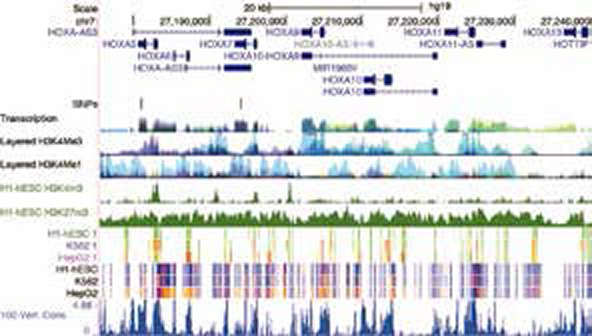
Epigenome of the human HOXA gene cluster visualized on the UCSC Genome Browser.
By analyzing chromatin structure, histone modifications, and DNA methylation patterns, the genomic regulatory states associated with cell differentiation, developmental stages, and human diseases are being elucidated.
Vast amounts of genomic data are analyzed integratively using bioinformatics approaches.
Neuroscience and Model Animal Research
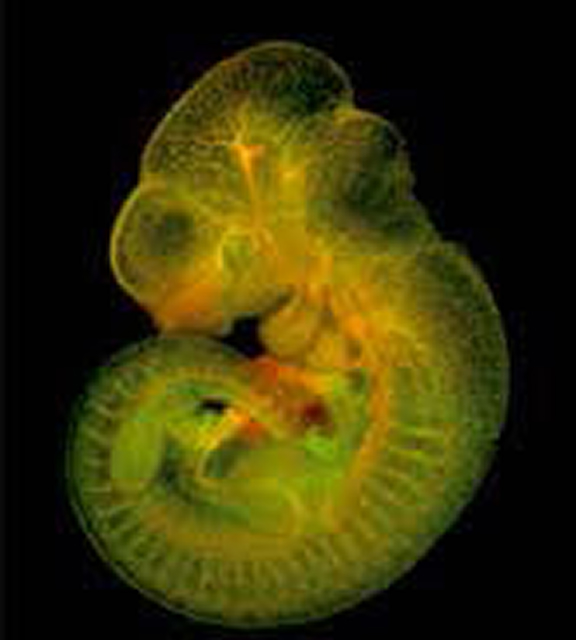
Another hallmark of basic medical research at the University of Tsukuba is the extensive use of genetically modified animals.
We place great importance on investigating the functions of various biological molecules and stem cells—a field of growing interest—within the context of living organisms.
Furthermore, there is a strong and sustained momentum to develop disease models in animals to understand both healthy and pathological states within the entire organism.
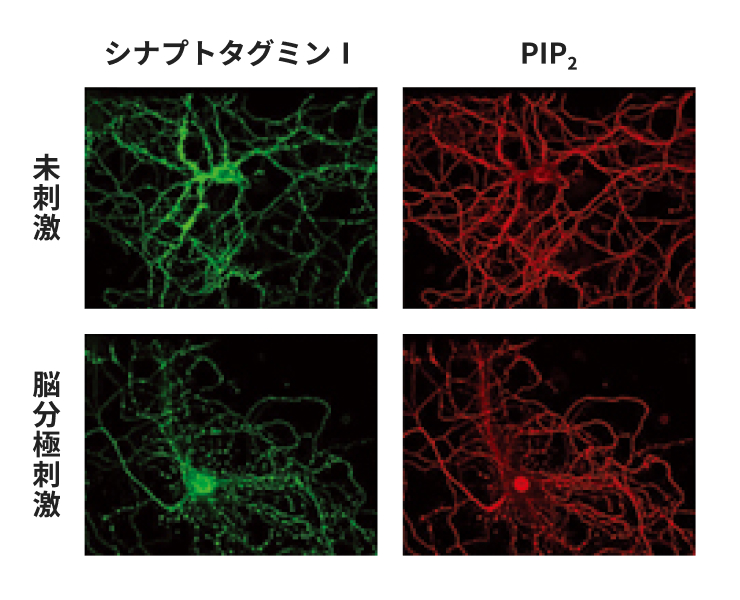
Modern cell biology techniques allow us to isolate various cells from animal organs and tissues for culture in Petri dishes, while also making it possible to easily visualize proteins and molecules within these cells.
When neurons isolated from a mouse brain are cultured, they extend long processes called axons and dendrites to form synapses with target neurons. (Left photo: Green spots indicate synaptic sites where the protein Synaptotagmin I has been visualized within the neurons).
Neurotransmission occurs when neurotransmitters are released in response to neuronal excitation (depolarization) and are subsequently received by the target neurons.
It has been discovered that specific molecules (Right photo: Red indicates the phospholipid PIP_2) are produced at synaptic sites only during depolarization, playing a crucial role in neural activity.
Such research is vital for understanding the molecular mechanisms underlying higher brain functions, such as learning and memory.
Cancer Research
Cancer research is also a highly active field here. We conduct studies on carcinogenesis caused by abnormalities in transcription factors and intracellular signaling molecules, as well as research on applying molecular biology to cancer diagnosis.
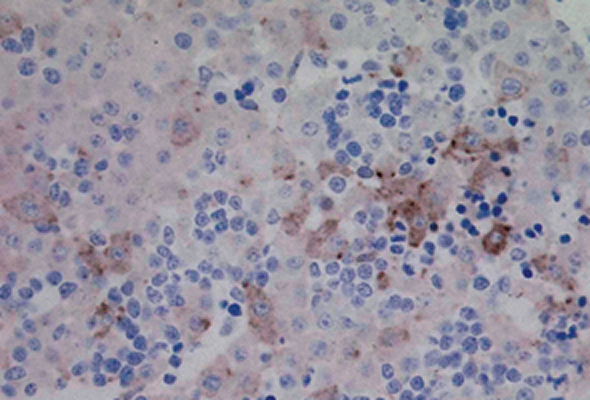
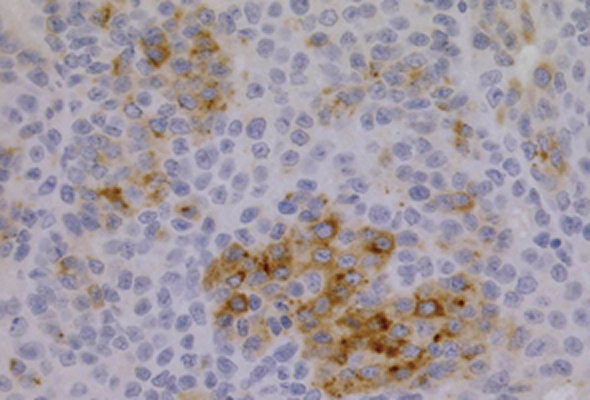
One characteristic of cancer is "atavism" (reversion to an ancestral state). Genes typically expressed in fetal tissues may reappear in cancerous tissues; these fetal proteins serve not only as markers for cancer diagnosis but also as potential targets for therapy.
The left image shows immunohistochemical staining of Dkk3, a protein characteristically highly expressed in early fetal stages, in a 5-week-old porcine fetal tissue.
Positive staining is observed in immature fetal hepatocytes, located alongside extramedullary hematopoietic cells within the fetal tissue.
The right image shows human hepatoblastoma tissue, demonstrating that this same fetal protein is also expressed within tumor cells.
